
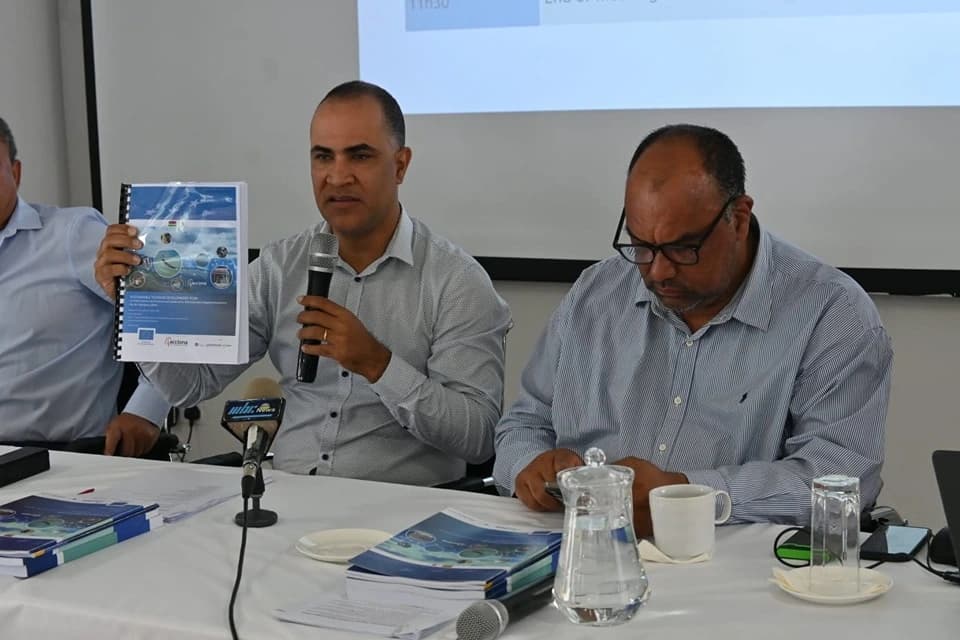
Chief Commissioner Franceau Grandcourt chairs the first meeting of the Central Task Force on the implementation of the Sustainable and Integrated Development Plan for Rodrigues (SIDPR 2023-2032) on Tuesday, July 30, 2024. © RRA
This is the first of two Daily Comments on the Sustainable Integrated Development Plan for Rodrigues (SIDPR), adopted by the Rodrigues Regional Assembly in 2023. It highlights the most overlooked passages of the SIDPR — the parts where the Rodrigues Regional Assembly itself calls for a Chamber of Commerce. The second article shows how these words have already turned into reality: the RCCI.
Introduction
Everyone talks about Rodrigues’ environment, its lagoons, and its coral reefs. Fewer talk about the economy. Yet in the 2023 update of the Sustainable Integrated Development Plan for Rodrigues (SIDPR), Section 7 stands out as one of the most honest passages in any gov-ernment plan: it acknowledges that without a strong private sector, the island’s future is compromised.
The text does not mince words. It recognises that innovation, entrepreneurship, and private initiative are indispensable to tackle social and environmental issues. It even prescribes the creation of a Chamber of Commerce and Industry — a formal platform for businesses to unite, represent themselves, and engage with the authorities. One might wonder why this “forgotten page” has been so overlooked when it contains the seeds of economic renewal.
The Forgotten Pages
Everyone talks about Rodrigues’ environment, its lagoons, and its coral reefs. Fewer talk about the economy. Yet in the 2023 update of the Sustainable Integrated Development Plan for Rodrigues (SIDPR), Section 7 stands out as one of the most honest passages in any government plan: it acknowledges that without a strong private sector, the island’s future is compromised.
The text does not mince words. It recognises that innovation, entrepreneurship, and private initiative are indispensable to tackle social and environmental issues. It even prescribes the creation of a Chamber of Commerce and Industry — a formal platform for businesses to unite, represent themselves, and engage with the authorities. One might wonder why this “forgotten page” has been so overlooked when it contains the seeds of economic renewal.
Let us read Section 7 in its own words:
“A core objective of the new SIDPR is to get the private sector to play a leading role to solve Rodrigues pressing social and environmental issues through new business strategy, new supporting / facilitation instruments easily accessible from potential investors, with a special attention for innovation, and creative entrepreneurship.” (SIDPR 2023, p. 127)
“Consequently, the core of the new SIDPR proposal to support private sector is to set up spe-cific facilities (technical assistance combined with financial support) especially designed to adapt to Rodrigues business environment and constraints. Thus, they could help not only to better face the local difficulties, as the private sector operators will feel more at ease with instruments expressly designed for them, but also strengthen the autonomy of the Rodrigues administration, as it will be able to manage autonomously and for its specific objectives the resources and to monitor them to increase effectiveness and impact.” (SIDPR 2023, p. 127)
“To support the emergence of new businesses as well as the consolidation of existing ones, special financial and technical assistance facilities will be established : they will have an embedded flexibility allowing to target / define specific conditions for their use (example: improve water efficiency and/or energy efficiency, facilitate island food security, support women businesses, start innovative businesses, sustain young entrepreneurs, develop main island touristic assets, start new blue economy enterprises, etc.).” (SIDPR 2023, p. 127)
“The rationale for PSD (Private Sector Development) is that it can be the most effective in-strument to provide for new jobs, especially for the young persons, allowing them to im-prove their incomes, laying the foundation for their improved living conditions. In addition, a growing private sector enables governments to generate sufficient tax revenue to provide essential public services such as health care and education. In this respect, SMEs are an im-portant focus for PSD support due to their large contribution to employment creation and poverty reduction.” (SIDPR 2023, p. 128)
“Private Sector Development promotes efficient economic growth and development and is a source of wealth, dynamism, competitiveness and knowledge. Beyond its economic merits, however, lie compelling social and political attributes that enhance the contribution private sector development can make more generally to sustainable development, the overriding goal of all development assistance efforts.” (SIDPR 2023, p. 128)
“Jobs and incomes created by private enterprises lead to more equitable diffusion of the benefits of growth to more people. In the case of microenterprises these factors are further enhanced by virtue of their particularly direct impact on poverty alleviation and on the inte-gration of women and other marginalised segments of society into economic life.” (SIDPR 2023, p. 129)
“PSD also engages people more actively in the productive and decision-making processes that affect their lives, furthering the goals of participatory development and good govern-ance. A growing private sector creates new stakeholders in the economy, advancing the de-velopment of a more pluralistic civil society that can lead to more accountable political sys-tems and rising labour standards.” (SIDPR 2023, p. 129)
“It is widely acknowledged that private sector works best, and growth increases most rapid-ly, when the public sector understands, values, and facilitates private sector activity; when economies establish a sound policy and regulatory environment complemented by the ser-vice and physical infrastructure required to enable business to function efficiently; and when investors recognise in a market the certainty, predictability, and confidence needed to make substantial and long-term commitments.” (SIDPR 2023, p. 129)
“The private sector in Rodrigues needs to be better represented so that it can relate with local and central authorities and to collaborate in the search of options and solutions. At the moment, an Association of Tourist Entrepreneurs exists, and an Association of Artisans has been recently established. The next step is to create the Rodrigues Chamber of Commerce and Industry, as the organisation that will group all the island private sector enterprises and who will represent them in front of the authorities.” (SIDPR 2023, p. 139)
“The establishment of a Rodrigues Chamber of Commerce and Industry (covering all sectors critical for the island economy, from agriculture to fishing, from manufacturing to services, etc.) should be an important step for the new and innovative role of private sector in the future development. It can become the formal representative of Rodrigues private sector in dealing with authorities, developing the advocacy role and then contributing to the estab-lishment of the classical tri-partite negotiation space (authorities – workers – enterprises).” (SIDPR 2023, p. 150)
“While the Chamber should be a private association, nevertheless the Rodrigues authorities can provide some help and guidance. Perhaps the Mauritius Chamber can also offer support.” (SIDPR 2023, p. 150)
The message is clear. The government’s own development plan does not merely tolerate the private sector; it calls for its leadership. And it identifies a missing institution — the Chamber of Commerce and Industry — as essential.
That page, often overlooked, may be the most consequential in the entire SIDPR. It shifts the narrative from state-led dependency to private-sector-led responsibility. It is, quite literally, the forgotten page that could decide Rodrigues’ economic future.
But does one really wonder why these lines were so easily ignored? Chamber work is hard work: largely voluntary, rarely glamorous, often underfunded. It means organising, representing, and building — without immediate profit. Not exactly everyone’s cup of tea. Which is precisely why this “forgotten page” matters: it asks for what is difficult but indispensable.

